

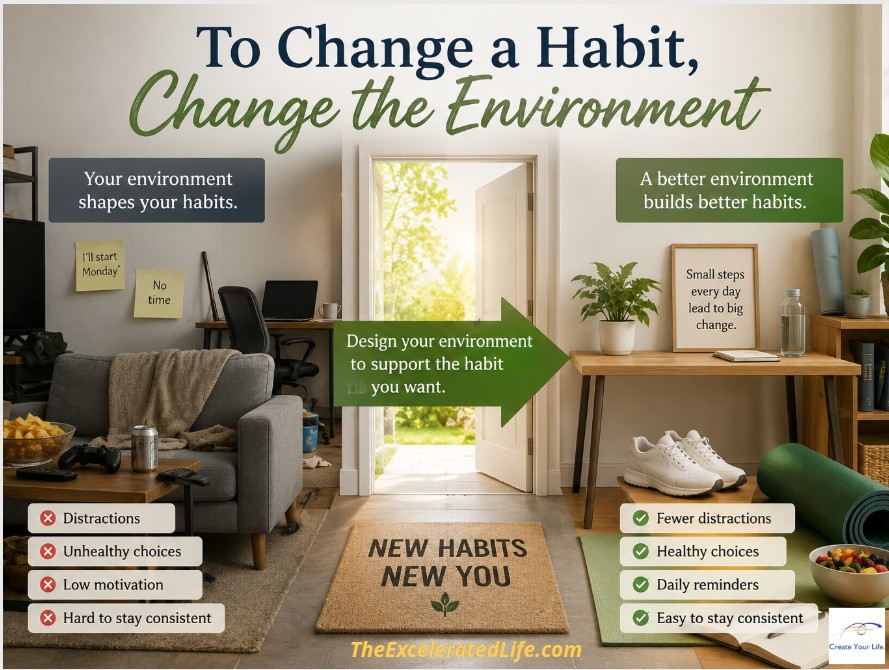
Your environment is always encouraging something. It is nudging you toward distraction or focus. Toward movement or inactivity. Toward intentional living or automatic behavior. The good news is this: You may not control every circumstance in your life, but you can influence many of the environments that influence you.
How Environment Hindered a Healthy Habit
“Often our behavior is shaped by subtle pressures around us but we fail to recognize these pressures.” ~ Benjamin Hardy
I just couldn’t understand it! I wanted to lose a few pounds plus I wanted to eat a healthier diet. I knew what to do, and I set an intention every morning to do it – avoid the sweets, and eat raw vegetables or fruit if I wanted a snack. It seemed so simple!
Why then did I keep sneaking cookies in the afternoon? There were plenty of carrots, celery, apples, and other delicious and healthy options in my refrigerator. Did I have so little willpower?
The Role of Environment
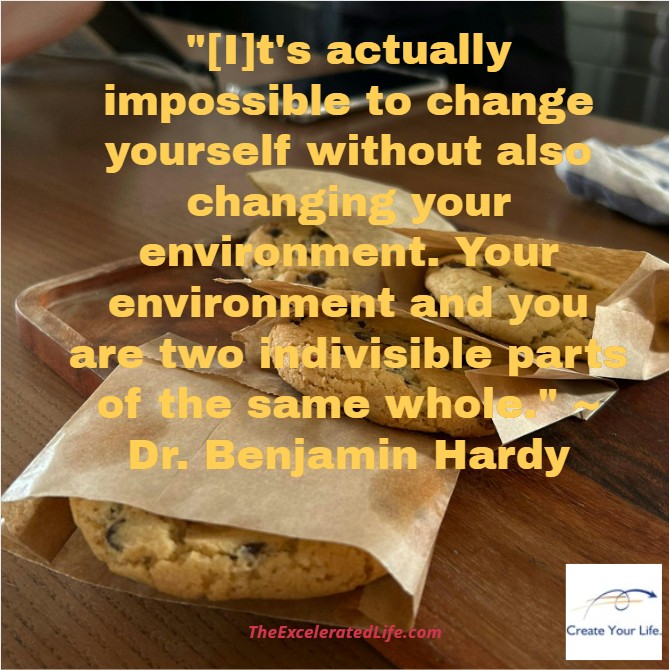
“Without question, each person is shaped by their environment. However, each person also has great power in creating and controlling the environments that will ultimately shape them.” ~ Benjamin Hardy
As I read and studied about habits and willpower, I slowly began to understand. Remember the Habit Loop? Every habit has three parts: the cue, the routine, and the reward.
- Cue: Something triggers the behavior.
- Routine: The actual behavior you perform.
- Reward: The benefit or relief you get.
In my case, the cue was obvious – I was hungry. And the reward was OK, too. The issue was in the actual behavior; reaching for the cookies in the front of the pantry, rather than digging the carrots out, washing them, and cutting them up.
How often do we run into similar obstacles as we seek to change a behavior? We just need to stop doing one thing and start doing something else. Simple, right?
But, in thinking this way, we ignore (or perhaps fail to understand) a critical factor. The environment in which we are operating. Like a fish surrounded by water, we are generally unaware of how our environment affects us. However, once we become aware of the power of our environment, we can use it to our advantage.
Strategies for Using Your Environment
“Environment is the invisible hand that shapes human behavior. We tend to believe our habits are a product of our motivation, talent, and effort. Certainly, these qualities matter. But the surprising thing is, especially over a long time period, your personal characteristics tend to get overpowered by your environment.” ~ James Clear
To understand how to set up your environment to make your new habit easier to maintain (or harder, if you’re trying to break an old habit), first decide what you want to do. Once you know that, use one or more of these strategies to help you design the proper environment.
The three strategies are: 1) Automate good decisions. 2) Align the new habit with your normal behavior. 3) Remove negative influences. So, decide on the habit you’d like to install, then think about how you could put these strategies to work.
Automate Good Decisions
I recently wrote in the Excelerated Life™ Newsletter about how we can use routines to help establish good habits. That is one example of how to automate good decisions.
Or, as I mentioned above, we can place the healthy snacks in an easy-to-reach location. Then what should we do with the unhealthy snacks? Well, the best option is not to bring them home in the first place. If that’s not possible (for example, if you have a family), then place them in a location that is difficult to reach.
Now, over to you: How could you modify your environment to automate your desired habit?
Get in the Flow
This strategy has you design your environment so that your new habit flows along with your usual behavior. Shawn Achor wrote about moving his TV remote to a drawer in his nightstand and placing a book he wanted to read on the coffee table. This made it easy for him to form the habit of reading instead of mindlessly watching TV.
As another example, research shows that you are more likely to visit the gym if it’s on your way home from work, even if it’s only five minutes in the opposite direction. When you can set up a habit pattern that is “in the flow” of what you’re already doing, you are more likely to keep it up.
How could you get your desired habit into the flow of your current environment?
Remove Negative Influences
We’ve touched on this in the previous examples, but let’s look at it specifically. One helpful way to use our environment to form positive habits is to eliminate temptations that can get us off track. As we mentioned earlier, making unhealthy foods harder to reach makes it less likely that we’ll choose them. Putting your phone away in a drawer or another room makes it less likely you’ll be on it and easier to wind down before bed.
What negative influences might be interfering with your habit practice? How can you use your environment to remove them?
Putting These Ideas Into Practice
Let’s take a practical example. Suppose you want to develop the habit of walking every morning. You could rely entirely on willpower and simply hope you’ll feel motivated when the alarm goes off. But environment-based habit design gives you a much better chance of success.
You might:
- lay out your walking clothes the night before,
- place your shoes beside the bed,
- charge your phone in another room so you have to get up,
- prepare a playlist or podcast ahead of time,
- and choose a walking route that feels enjoyable and convenient.
Notice what’s happening here. You are reducing friction for the desired habit and increasing friction for the undesired behavior. Instead of fighting yourself every morning, you are allowing your environment to support the person you are trying to become.
And this principle works almost everywhere:
- Want to read more? Put a book where you usually scroll.
- Want to eat healthier? Prepare healthy food before you are hungry.
- Want to practice gratitude? Leave a journal beside your bed.
- Want less screen time? Remove social media apps from your phone.
Small environmental shifts create surprisingly large behavioral changes over time. Because habits are not usually won or lost in moments of heroic discipline. They are quietly shaped day by day from the environments we repeatedly step into.
How Environment Helped a Healthy Habit
Once I understood the role my environment was playing, things began to change. The cookies disappeared from the front of the pantry. Healthy snacks became easier to grab. Carrots were washed and ready. Apples sat where I could see them. The better choice became the easier choice. And something surprising happened. I didn’t suddenly become a person with massive willpower. I simply stopped fighting my environment every afternoon.
That’s an important distinction. Many of us assume our struggles are moral failures or character flaws when they are often environmental mismatches. We are trying to build healthy habits in environments designed for distraction, convenience, comfort, and instant gratification.
But once we begin intentionally shaping our environment, our habits begin to change more naturally. And over time, those habits begin to shape us.
A Call to Action
Choose one habit you want to strengthen this week. Then make one environmental change that makes that habit easier to practice. It doesn’t have to be anything dramatic. Don’t make it complicated. But do it with intention.
Because sometimes the path to a better habit begins with something as simple as moving the cookies.
The Real Power of Environment
Your environment is always encouraging something. It is nudging you toward distraction or focus. Toward movement or inactivity. Toward intentional living or automatic behavior. The good news is this: You may not control every circumstance in your life, but you can influence many of the environments that influence you. And that is empowering. Excelerated Habits™ are not built solely through discipline and determination. They are built through awareness, preparation, and intentional design.
The most important question is not: “How can I force myself to change?”, but “How can I make the right behavior easier?”
That small shift in thinking changes everything.
Habits and Environment
If you want to change a habit, don’t focus only on your attempts. Look around. What in your environment is supporting the behavior you want? What is quietly working against you? Then begin making small adjustments.
Remove friction from the habits you want to build. Add friction to the habits you want to break. Because lasting change rarely happens through heroic effort alone. More often, it grows out of environments that quietly support the life you are trying to create. And that is your Excelerated Life™!
What in your current environment is quietly shaping your habits?
Which healthy habit could become easier with one small environmental change?
Share your thoughts by leaving a comment below.
Excelerated Habits™ — automating your best behaviors — is one practice for creating your Excelerated Life™, a life of flourishing and well-being, and a life of meaning, purpose, and service.
Read more about the Excelerated Life™.
Resources:
Achor, Shawn. The Happiness Advantage. New York: Crown Publishing Group, 2010.
Clear, James. Atomic Habits: Tiny Changes, Remarkable Results. New York: Avery, an imprint of Penguin Random House LLC, 2018.
Hardy, Benjamin. Willpower Doesn’t Work. New York: Hachette Book Group, Inc, 2018.
This blog post includes research findings and suggestions from ChatGPT, an AI language model developed by OpenAI. The content was generated with AI assistance and is intended to provide information and guidance. Please note that the suggestions are not official statements from OpenAI. To learn more about ChatGPT and its capabilities, you can visit the OpenAI website.