

Acceptance does not mean you approve of everything that happens. It means you stop wasting energy denying what is true. Accept your reality. That is the path of Excelerated Acceptance™.
Good Luck? Bad Luck?
An old Chinese farmer[1] had a horse on which he relied for his farm work. But one day, the horse ran away. “Oh, no!” his neighbor cried. “That is bad luck!” “Bad luck? Good luck? Who can say?” the old farmer replied.
Then the horse came back and brought several more wild horses with it. “What good luck!” cried the neighbor. “Good luck? Bad luck? Who can say?” said the farmer.
The farmer gave one of the wild horses to his son. But as he worked to tame it, the horse threw him, and his leg was broken. “Oh, my! Such bad luck!” said you-know-who. “Bad luck? Good luck? Who can say?”
Then, during the next week, the emperor’s men came and took every able-bodied young man to fight in a war. Because of his injured leg, the farmer’s son was spared. Good luck? Bad luck? Who can say?
Good? Bad? Who Can Say?
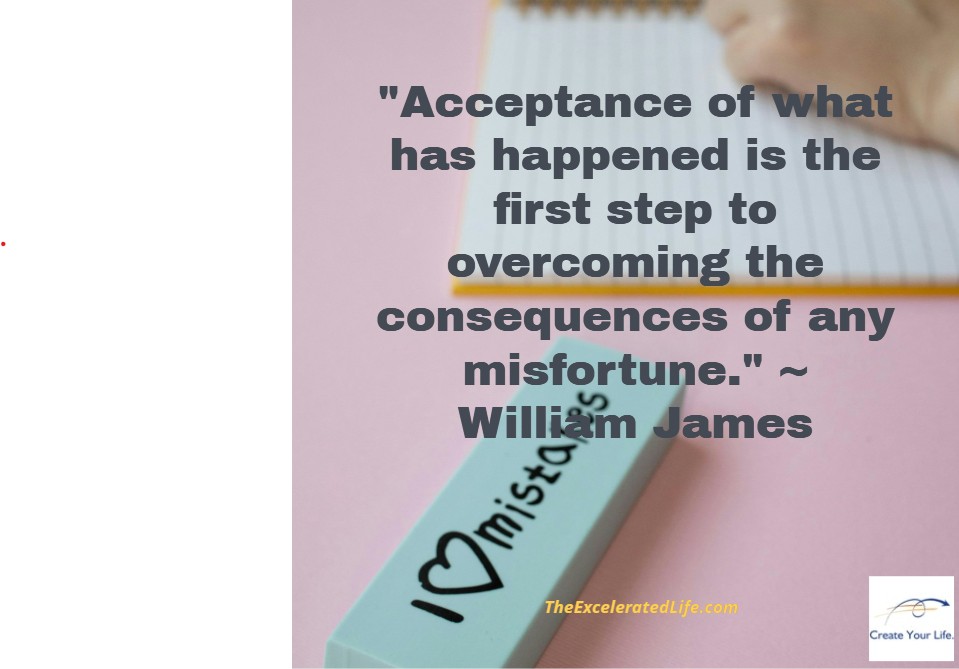
“The first step toward change is awareness. The second step is acceptance.” ~ Nathaniel Branden
When I first heard this fable several years ago, it spoke to me of the power of acceptance. I was quick to label an event “good” or “bad” based on what was happening at the time, without knowing or even considering the eventual outcome. And that made it difficult to accept the things I labeled as “bad”.
That led to unhelpful thoughts of “Why is this happening to me?” Those thoughts made it impossible to accept the reality of the situation. And that refusal meant that I ended up wallowing in self-pity instead of working to change what I could.
I first encountered the deeper concept of acceptance through the work of the late Thomas J. Leonard, often called the father of Life Coaching. Leonard taught that we must accept all parts of ourselves — strengths and weaknesses, talents and flaws, victories and blemishes.
That doesn’t mean we stop growing. It means we stop wasting energy arguing with reality.
Why Acceptance Matters
Before we can change anything, we have to accept what is, a.k.a. the current reality. But hear this: Ignoring circumstances or events is not the same as accepting them. Pretending something didn’t happen and “putting on a happy face” are not practices of acceptance.
Acceptance simply means seeing reality clearly enough to respond wisely.
Some situations are within our influence. Others are not. But in either case, fighting reality drains our energy and clouds our judgment. Acceptance gives us solid ground to stand on. And from solid ground, we can move forward.
The Power of Acceptance
Acceptance is not a passive practice if we are going to put its power to use. Saying or thinking we are accepting our current situation by hunkering down and ignoring it is not what we mean by acceptance. However, an important first step is to accept the current situation as it is – “to accept the things I cannot change”. Don’t waste time wishing for a different outcome or engage in “what ifs” and “if onlys”.
Once you’ve taken that first step, consider these possibilities.
No blame. No shame.
Blame keeps us stuck in anger. Shame keeps us stuck in defeat. Neither helps us grow. When we begin asking, “What can this teach me?” instead of “Who is at fault?” we open the door to growth, resilience, and wisdom.
Regroup before reacting.
A painful experience can leave us emotionally stunned. Disappointed. Embarrassed. Angry. Hurt.
So stop.
Take a breath.
Take a walk.
Pray.
Rest.
Talk to someone wise.
A little self-care is healthy. A permanent pity party is not.
Take some action.
One of the best ways to avoid sinking into negativity is to move.
Clean something.
Exercise.
Make one phone call.
Handle one small task.
Help another person.
Action restores momentum. Momentum restores hope.
Accept that struggle is part of life.
No one gets a lifetime exemption from difficulty. Every meaningful life includes setbacks, disappointments, uncertainty, and pain. The goal is not to avoid struggle altogether. The goal is to become stronger, wiser, and more compassionate through it. Feel the pain. But don’t build a vacation home there.
Embrace hope.
Hope is not wishful thinking. Hope is the belief that the future can improve and that your actions matter.
Hope says:
“I can learn.”
“I can grow.”
“I can adapt.”
“This is not the end of the story.”
A Clarifying Example
Suppose someone loses a job unexpectedly. At first, the situation feels completely “bad.” Fear kicks in immediately:
What will happen financially?
What will people think?
What if I never recover?
Without acceptance, that person may spend weeks replaying the injustice, blaming others, or denying reality. But acceptance changes the starting point.
Acceptance says:
“Yes, this happened.”
“Yes, this hurts.”
“Yes, this creates uncertainty.”
But then comes the important question:
“Now what?”
Maybe the loss becomes an opportunity to pursue work more aligned with personal values. Maybe it becomes the push needed to learn a new skill. Maybe it reveals strengths that would have remained hidden otherwise.
The job loss may still be painful. Acceptance does not magically erase difficulty. But acceptance creates movement. Resistance creates paralysis. One moves us forward. The other keeps us emotionally parked in the driveway with the engine running.
Small Practices for This Week
Here are a few ways to practice Excelerated Acceptance™ this week:
- When something frustrating happens, pause before labeling it “good” or “bad.”
Ask: “What do I actually know right now?” - Catch one “if only…” thought and replace it with:
“What can I do next?” - Spend five minutes journaling about a current struggle. List:
– What you cannot control
– What you can influence
– One small next step - Practice the phrase:
“This is what is happening right now.”
Not forever. Not always. Right now. - When facing disappointment, ask:
“What might this experience be trying to teach me?” - Take one meaningful action within 24 hours of a setback — even if it’s small.
The Power of Acceptance – Reprise
Not everything we need to learn comes through positive experiences. Sometimes life has to interrupt us before it can redirect us. Sometimes struggle develops strengths we would never build otherwise.
What challenge is life placing in front of you right now? What reality are you resisting instead of accepting?
Acceptance does not mean you approve of everything that happens. It means you stop wasting energy denying what is true.
Accept your reality.
Stand on solid ground.
Then take the next step forward.
That is the path of Excelerated Acceptance™. And that is embracing your Excelerated Life™!
Is there something in your life you are struggling to accept?
Repeat after me: “This happened. Now, what can I do?”
Share your experience by leaving a comment below.
Excelerated Acceptance™ – identifying and accepting the things you are struggling with — is one practice for creating your Excelerated Life™, a life of flourishing and well-being, and a life of meaning, purpose, and service.
Read more about the Excelerated Life™.
Footnotes:
[1] Adapted from Cleveland.com: Parable of a Chinese Farmer
https://www.cleveland.com/living/2009/02/parable_of_a_chinese_farmer_ho.html
Resources:
Leonard, Thomas. The 28 Laws Of Attraction. New York: Scribner, 1998.
This blog post includes research findings and suggestions from ChatGPT, an AI language model developed by OpenAI. The content was generated with AI assistance and is intended to provide information and guidance. Please note that the suggestions are not official statements from OpenAI. To learn more about ChatGPT and its capabilities, you can visit the OpenAI website.