

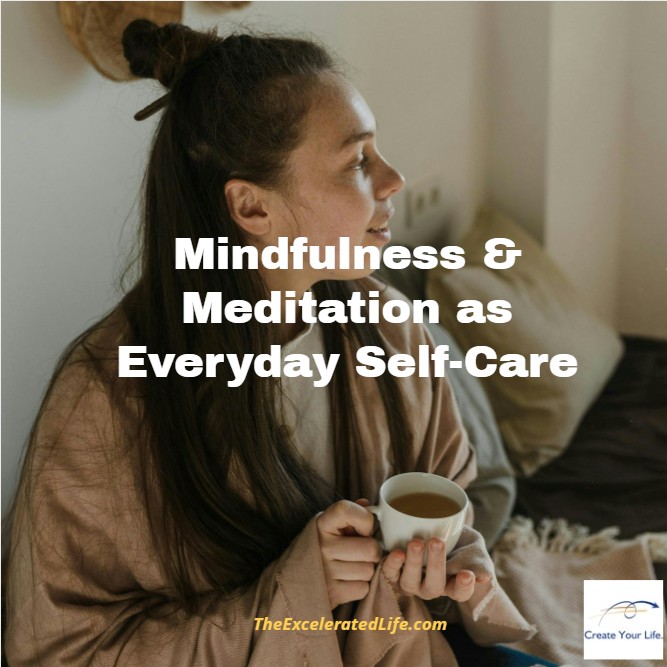
Mindfulness helps us care not only for the body, but for the mind and spirit as well. It restores reserves. It reduces mental clutter. It helps us become more present with others. And it helps us become more present with ourselves.
[Title Photo by Arina Krasnikova]
The Day That Never Stops
It wasn’t a bad day. In fact, it was a completely ordinary day. Nothing dramatic went wrong. No crisis. No emergency. Just a steady stream of activity from the moment her day began.
Emails before breakfast.
A quick glance at the news.
A calendar already full.
A conversation half-listened to while thinking about the next task.
But by mid-afternoon, that feeling had set in. Subtle. Familiar. It was a completely ordinary day, but like so many of her days lately, Deborah felt restless. Scattered. A little behind, no matter how much she got done.
And by evening, even the quiet moments weren’t quiet. Her body was still, but her mind kept moving. Replaying conversations. Planning tomorrow. Carrying the day forward. That’s when the realization came to her: The problem isn’t just how much I’m doing . . . It’s that I never actually stop. Not really. No pause. No reset. No space between one moment and the next. Just motion.
This is where mindfulness begins, not as a technique, but as a recognition that something in us needs quiet, and stillness.
Because selffulness doesn’t require doing something more. It’s learning how to stop. That’s how we use mindfulness for self-care.
Why Mindfulness Matters
You and I live in a culture of constant input. Phones. Tablets. Incessant notifications. 24-hour news. Social media that’s always “on”. A recent study shows the average worker is interrupted 275 times during the workday. And those interruptions spill over into after-work hours.
When our attention is fragmented by all these interruptions, stress levels increase. Like Deborah, we don’t always recognize the source, but the feelings are there. Restless. Scattered. The feeling of never being caught up. And without awareness, we live reactively.
When we practice mindfulness, just for short periods during the day, we can counteract these feelings. In this way, it becomes a part of our Excelerated Selffulness™ practice. It supports:
- better decisions
- calmer responses
- clearer thinking
Here’s a question for you: When was the last time you sat quietly without input?
What Mindfulness Actually Is (And Isn’t)
Let’s first define what we mean by mindfulness.
Simply put, for our discussion, mindfulness is being present in the moment, paying attention to what’s happening now, and noticing our thoughts without judging them.
Mindfulness is not emptying your mind (an impossibility, anyway). It does not require you to be perfectly calm. And for our purposes, it is not a spiritual practice.
In essence, mindfulness is noticing what is happening, inside and around you, without immediately reacting.
Meditation as a Practical Tool
Often, when we hear “mindfulness”, we think of meditation. And that’s right on target. Meditation is simply a structured mindfulness practice.
Some people shy away from meditation because they believe it requires you to completely empty your mind or sit motionless for 30 minutes or do some “woo-woo” incantation.
But in reality, you don’t need silence. You simply observe. You don’t need 30 minutes. As little as one minute of focused breathing can help. And you don’t need to be perfect. You simply need to practice.
Some Personal Practices
Including a meditation practice as part of your morning routine can help you start the day in a positive way. Here are a few ways I incorporate meditation into my morning. Maybe one of them will appeal to you.
A LovingKindness Meditation
I adapted this one from Barbara Fredrickson’s Positivity book.
Sit quietly with your feet on the floor and your hands resting in your lap.
Take a slow breath in for a count of six. Breathe out for a count of eight.
Repeat six times.
Continue the slow breaths and repeat this quietly in your mind:
May I be filled with LovingKindness.
May I be safe from all inner and outer dangers.
May I be healthy and well in body, mind, and spirit.
May I love and be loved.
May I be at peace.
May I prosper, and flourish, and be filled with hope.
May I be blessed.
Repeat this, replacing “I” with the names of various family members, friends, or loved ones.
Finish by replacing “I” with “All creatures”, or “All people”, as in “May all creatures be filled with LovingKindness”, etc.
Slowly open your eyes and take a deep breath.
Stand up and begin your day.
A Contemplative Prayer
This one comes from Richard Rohr’s book, The Divine Dance.
Sit quietly and do the slow breathing as above.
Repeat this quietly, pausing after each line:
Be still and know that I Am God.
Be still and know that I Am.
Be still and know.
Be still.
Be.
Rest in the quietness and listen . . .
A Gratitude Meditation
This is from Ready, Set, Slow by Lee Holden.
Find a quiet place. Sit comfortably and close your eyes.
Begin the slow, deep breathing.
Feel the support of the surface beneath you and be grounded in the present moment.
Shift your focus to what you are grateful for. Begin with small things you notice right now, the air you are breathing, the beating of your heart.
Shift your focus to the everyday blessings that your home provides: running water, food in the refrigerator, a safe, warm place to sleep, heating and air conditioning, clean clothes in the closet. Be grateful for the small things that so many in the world do not have.
Now, bring to mind a person you are grateful to have in your life. Recall the impact they have had and mentally express your thanks to them.
Redirect your gratitude inward and reflect on your own qualities, strengths, and achievements. Think of the challenges you’ve overcome and be thankful for your growth.
Expand out to the world around you, to the beauty of nature and the interconnected tapestry of all life and let gratitude arise in you.
Take a few deep breaths, and relish in the feeling of thankfulness.
Slowly open your eyes, smile, and begin your day.
The Benefits of Mindfulness as Self-Care
“You don’t have time not to slow down. In the face of burnout, lack of passion, and endless to-do lists, what if to achieve more you need to do less.” ~ Lee Holden
As our lives become filled with more tasks to complete, more opportunities, more obligations, and more demands for our time and attention, it is important to care for ourselves in order to cope and to make a contribution. And mindfulness is a beneficial form of self-care. Here are some of the ways it can help.
- Promotes clearer thinking and less overwhelm.
- Reduces our reactivity and helps us find more patience.
- Lowers our stress response and promotes better sleep.
- Improves relationships through better listening and calmer communication.
Common Obstacles (And Gentle Truths)
Of course, we can always find reasons not to make the effort to be more mindful, regardless of the perceived benefits. Here are some of the reasons (or excuses) we find and reasons to do it anyway.
Obstacle 1: “I don’t have time.”
Truth: You don’t need time. You need intention. How long you engage in a mindfulness practice isn’t the point. Even a minute or three can be helpful.
Obstacle 2: “I can’t quiet my mind.”
Truth: That’s not the goal. Noticing is the goal. Completely quieting your mind is not possible. And not necessary.
Obstacle 3: “Oh! I forgot.”
Truth: That’s why we build small cues and routines.
How To Start (Keep It Small)
One of the reasons people avoid mindfulness practices is that they imagine they must overhaul their lives to do them “correctly.” But mindfulness isn’t built through intensity. It’s built through repetition. Small moments. Repeated consistently.
In fact, trying to do too much too quickly often defeats the purpose. We can turn mindfulness into another task to master, another performance to perfect, another item on the checklist. But mindfulness works best when it becomes woven naturally into everyday life. So start small enough that you can’t reasonably fail.
Try something like this:
- One minute of slow breathing before getting out of bed.
- Three mindful pauses during the day.
- One reflection question before sleep:
“What am I carrying right now that I don’t need to carry into tomorrow?”
That’s enough. You don’t need a perfect meditation room. You don’t need incense, special music, or an hour of uninterrupted silence. You simply need willingness. Mindfulness grows through practice, not performance.
And here’s something important to remember: some days your mind will feel calm and focused. On other days, it may feel noisy, distracted, and restless. Both kinds of days are normal. Both are part of the practice. The goal is not to become someone who never feels stress. The goal is to become someone who notices stress earlier, responds more calmly, and returns more quickly to center.
That is progress.
An Action Plan
This week, choose one simple mindfulness practice and repeat it daily. Not perfectly. But consistently.
Maybe it’s one minute of breathing in the morning.
Maybe it’s pausing before meals.
Maybe it’s sitting quietly for sixty seconds before opening your phone.
Start small and notice what changes when you stop living every moment in motion.
The Real Power of Mindfulness
Mindfulness does not remove stress from life.
Traffic still happens.
Emails still arrive.
Schedules still change.
Difficult people still exist.
Mindfulness changes something else. It changes how you meet those moments. Without awareness, we react automatically. We tense up, speed up, get frustrated, spiral mentally, or carry emotional residue from one part of the day into another.
But mindfulness creates a pause. And inside that pause is choice. A breath before responding. A moment of awareness before reacting. A chance to return to the present moment instead of being dragged through the day by distraction, anxiety, or emotional momentum.
This is why mindfulness is such an important part of Excelerated Selffulness™. It helps us care not only for the body, but for the mind and spirit as well. It restores reserves. It reduces mental clutter. It helps us become more present with others. And perhaps most importantly, it helps us become more present with ourselves.
Because the truth is, many of us are physically present in our lives while mentally somewhere else. Mindfulness gently brings us back.
Back to this breath.
Back to this moment.
Back to this life.
You don’t need more time. You don’t need a perfect routine. You don’t need to become a different person overnight.
You simply need a moment of awareness . . . repeated.
So take a breath before reacting; a pause before rushing; a few quiet moments before the noise of the day takes over. Small acts of mindfulness may not seem dramatic. But over time, they reshape the way we experience life itself. Because life is not happening someday. It is happening now. And the more present we become, the more fully we are able to live it. And that’s how you embrace your Excelerated Life™!
When do you most need a pause during the day?
How can you plan for that now?
Share your experience by leaving a comment below.
Excelerated Selffulness™ — taking excellent care of yourself — is one practice for creating your Excelerated Life™, a life of flourishing and well-being, and a life of meaning, purpose, and service.
Read more about the Excelerated Life™.
Resources:
Fredrickson, Ph.D., Barbara, L. Positivity. New York: Crown Publishing Group, 2009.
Holden, Lee. Ready, Set, Slow. Boulder, CO: Sounds True, Inc., 2025.
Rohr, Richard with Mike Morrell. The Divine Dance: The Trinity and Your Transformation. New Kensington, PA, Whitaker House, 2016.
This blog post includes research information and suggestions provided by ChatGPT, an AI language model developed by OpenAI. The content was generated with AI assistance and is intended to provide information and guidance. Please note that the suggestions are not official statements from OpenAI. To learn more about ChatGPT and its capabilities, you can visit the OpenAI website.
(Please NOTE: The material in this document is intended for informational and educational purposes only and is not a substitute for professional advice in medical, psychological, legal, or financial matters. The purpose of this article is to educate and inspire. Following the techniques, suggestions, or strategies presented does not guarantee success.)