

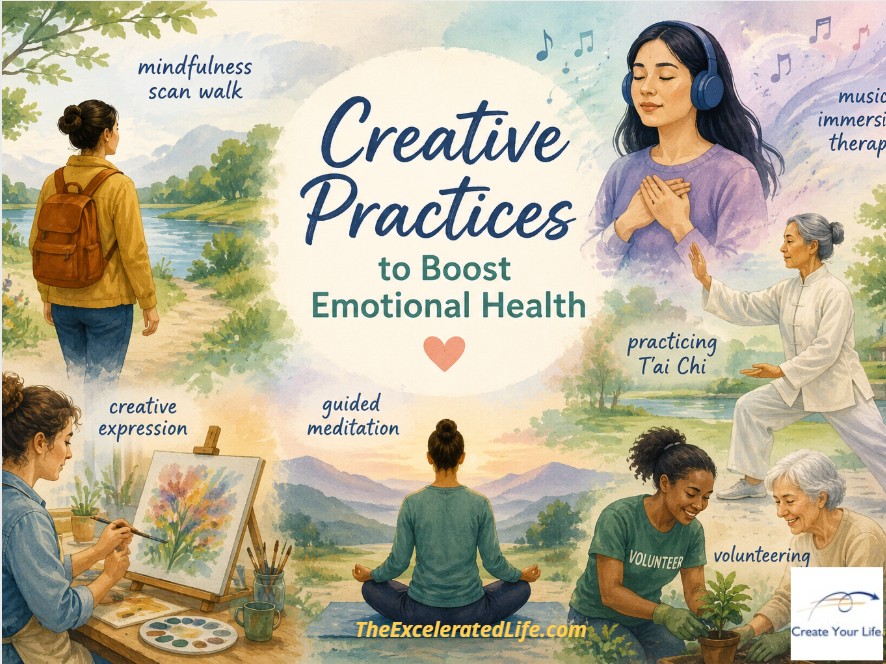
When life is full, mental wellness reflection can start to feel like one more task, and even good ideas fade without routine incorporation. The steadier path is adopting novel strategies as small experiments, simple, repeatable creative practices that fit your real schedule and energy. Over time, that approach supports personal growth through wellness, helping emotions feel more manageable and choices feel more intentional. Small, repeated creative acts build sustained emotional health.
Busy parents juggling work, caregiving, and the mental load often find that stress doesn’t announce itself, it simply becomes the background of everyday life. Even with rising mental health awareness, many people still face emotional wellbeing challenges that don’t look like a crisis, just a steady drain on patience, sleep, and focus. That’s where everyday mental wellness matters: small, realistic shifts that strengthen emotional resilience when life keeps moving. Exploring innovative mental health strategies can open up new ways to feel steadier and more like themselves.
Understanding Alternative Mental Health Practices
Sometimes it helps to name the options. Alternative mental health practices are supportive, non-traditional ways to care for your emotional life alongside, not instead of, therapy or medication. They broaden your mental health toolkit with holistic emotional support, often by strengthening the mind-body connection through creative mental health interventions.
This matters because stress can be subtle, and you need more than one tool to meet different days. When 92% of employees say access to mental health resources is critical in their workplace, it signals a real demand for practical, everyday support that fits real schedules.
Think of it like building a small “first-aid kit” for feelings. One day you might need a brisk walk and breathwork; another day you might need music, journaling, or a quick collage to release what you cannot say out loud. That same gentle creativity can also come from AI-aided art, even if you do not feel artistic.
Use AI-Assisted Drawing for a 10-Minute Emotional Reset
Once you start exploring alternative practices, it helps to have at least one option that’s truly low-pressure and easy to begin. Creating art with AI tools can support everyday mental and emotional wellness by giving you a simple way to express what you’re feeling, especially when words feel hard to find. Because you don’t need traditional drawing skills, the process can feel playful instead of performance-driven, which makes it easier to experiment and let your mood guide you.
With an AI drawing generator, you can create unique illustrations using just a few descriptive prompts, then watch an idea take shape in minutes. That quick “I made something” moment can bring a sense of accomplishment, spark creativity, and invite a calmer state of mind. If you want a concrete place to try it, you can generate drawings with Adobe Firefly using short, descriptive phrases.
Try 9 Offbeat Practices to Boost Mood This Week
If the 10-minute AI-assisted drawing reset helped you “unstick” your feelings, think of this as a bigger menu of experiments, some tiny, some adventurous. Pick one or two to try this week and keep the pressure low: you’re collecting data, not chasing perfection.
- Do a 12-minute sensory mindfulness “scan walk”: Step outside and slowly name 5 things you see, 4 you hear, 3 you feel on your skin, 2 you smell, and 1 you taste or imagine tasting. The point is to give your nervous system something concrete to hold onto, which can soften rumination. If you want to tie it to your drawing practice, jot down three “sensory words” afterward (silver light, wet bark, warm air) and use them as prompts for a quick sketch.
- Try a guided meditation variation that matches your mood: If you’re restless, choose a walking meditation (10 minutes, slow steps, count 1–10 and restart). If you’re emotionally flooded, try a body-based option like a 5-minute “soften and release” scan from forehead to toes. If you’re tired, use a compassion variation: repeat “This is hard, and I’m here” on each exhale for 3 minutes.
- Use “fresh” journaling techniques instead of a standard diary page: Do a 7-minute “Two Columns” page: left side What my mind keeps saying, right side A kinder, truer response. Or try a “Weather Report” entry: “Today my mood is ___ with patches of ___; the forecast is ___.” This keeps journaling short, specific, and less likely to turn into spiraling.
- Practice tai chi for a mood-friendly reset: Search for a beginner routine and repeat the same 8–15 minutes daily for a week so your body learns it. Focus on slower exhalations and smooth weight shifts rather than “doing it right.” Evidence suggests Tai Chi therapy can reduce depression scale scores in young people with depressive mood, and many adults find the steady pace calming too.
- Build a tiny forest garden corner (even in a pot): Choose 3 layers: one “canopy” plant (dwarf berry shrub), one “understory” (herbs), and one ground cover (strawberries or creeping thyme). Spend 15 minutes, twice this week, doing one simple task: watering, mulching, or pruning, no big overhaul. Research suggests gardening can lower stress, improve mood, help with focus, and forest gardening adds a satisfying sense of “slow growth” progress.
- Try music immersion therapy with a simple 3-track arc: Put on headphones and choose (1) a grounding track, (2) an emotion-matching track, and (3) a gentle “shift” track that’s slightly more hopeful or spacious. Sit or lie down and do nothing else for 10 minutes, no scrolling, no multitasking, so your brain can fully process the sound. Afterward, name the feeling that changed even 5% (tightness, energy, sadness, relief).
- Do volunteerism for mental health in a “micro-dose” format: Pick one cause and commit to 30–60 minutes once this week: write two supportive messages for a peer hotline training exercise, pack supplies at a pantry, or do a neighborhood trash pickup with one friend. Aim for roles that feel emotionally safe and clearly bounded. Helping in a contained way can increase purpose without draining you.
- Explore equine-assisted therapy, or a lower-stakes horse connection: If a certified program is available, book a single introductory session (many are groundwork-based, not riding). The core practice is noticing your body cues while you communicate calmly and consistently, horses respond to tension fast, which makes this great for learning regulation. If therapy isn’t accessible, try a “horse calm” substitute: watch 10 minutes of quiet horse grooming videos, then practice the same slow breathing pace.
- Plan one nature-connection activity with a clear “finish line”: Choose something concrete: sit by a tree for 8 minutes, collect 5 interesting leaves, or take 10 photos of “small beauty” (moss, shadows, sidewalk flowers). When you get home, make a 2-minute collage page or a quick AI-assisted sketch prompt using your favorite photo. These small completions build momentum, especially on days when motivation is low.
Choose the options that fit your energy, access, and comfort level, then notice what shifts, sleep, irritability, focus, or how quickly you recover from stress. That clarity makes it easier to weigh which practices deserve a regular spot in your week.
Mental Wellness Options Compared at a Glance
To make the choice easier, here is a side by side look at a few approaches and what they tend to offer. Emotional wellness is closely tied to your ability to handle life’s stresses so the goal is not to do everything, but to pick what supports you best today.
| Option | Benefit | Best For | Consideration |
| Sensory scan walk | Lowers mental noise through concrete cues | Rumination, overthinking, screen fatigue | Weather and mobility can limit consistency |
| Mood matched meditation | Targets regulation based on current state | Restless, flooded, or tired days | Can feel frustrating if you expect instant calm |
| Two column journaling | Builds self compassion and cognitive flexibility | Self criticism, worry loops | May intensify feelings if you write too long |
| Tai chi mini routine | Gentle movement plus steady breathing | Tension, irritability, low energy | Learning curve and space can be barriers |
| 3 track music arc | Shifts mood via focused listening | Rapid stress resets, transition moments | Headphones and quiet time help effectiveness |
If you want the simplest entry point, choose the option with the lowest friction for your day and schedule. If you want deeper change, pick one that trains a skill you can reuse, like reframing, breath pacing, or attention control. You can trust yourself to start small and still make it meaningful.
Turning Creative Practices Into a Steady Mental Wellness Routine
When life is full, mental wellness reflection can start to feel like one more task, and even good ideas fade without routine incorporation. The steadier path is adopting novel strategies as small experiments, simple, repeatable creative practices that fit your real schedule and energy. Over time, that approach supports personal growth through wellness, helping emotions feel more manageable and choices feel more intentional. Small, repeated creative acts build sustained emotional health. Choose one practice to try for the next seven days, and keep it light enough that it’s easy to repeat. That kind of motivational encouragement, followed by consistency, builds resilience you can lean on in busy seasons.
Judy Stephens, creator of GivenLove.org, had dreamt of being a mother since she was a little girl. After marrying her high school sweetheart, she gave birth to a baby boy within a few months, followed by two little girls in the next five years. Her own children were healthy and happy, but she knew not every child was as fortunate. After reading about a local child who had suffered greatly, she became a foster parent. Over the past eight years, she has cared for more than twenty children, learning valuable lessons in patience, persistence, and gratitude along the way. She feels blessed to have been given so much love.
With GivenLove.org, she hopes to spread the word about the joys of fostering and provide information on how anyone interested can start the process of becoming a foster parent.