

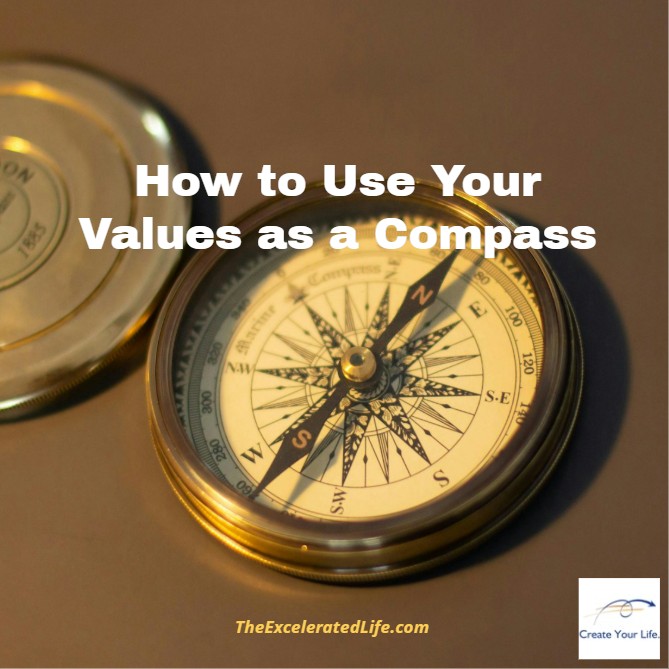
When you use your values as a compass, your life is aligned with your Valid Values, the principles you have chosen deliberately. Then you experience something powerful, a quiet sense that your life fits.
When Success Doesn’t Feel Successful
When Erik(*) joined the software company where I worked, I was quite impressed. He had finished college and gone to work right away in his chosen field. By contrast, I dropped out of college, bummed around for a few years, and worked at several different jobs before returning to school in my late twenties. I was over 30 when I began working in software development. At twenty-four, Erik had what I considered my dream job, one that took me a decade to figure out. Here was a guy who knew where he wanted to go and who lost no time in getting there.
So I was taken aback one day at lunch when Erik confided in me that he felt unfulfilled in his work. “It just doesn’t bring me the joy that I anticipated when I set this as my target, my dream job,” he lamented. Even though he had set a goal and worked diligently to reach it, it did not result in fulfillment. Where I saw the job as a chance to help and serve others, to be in a state of constant learning, and to take care of my family, he saw it as drudgery, a weight on his shoulders. Same job, two vastly different interpretations.
I couldn’t have articulated it then, but as I read, studied, and trained as a Transformational Life Coach, I came to realize that success not aligned with values feels “off”. It sometimes doesn’t feel like success at all. That’s where Excelerated Values™ come into play.
Start With Values (Not Goals)
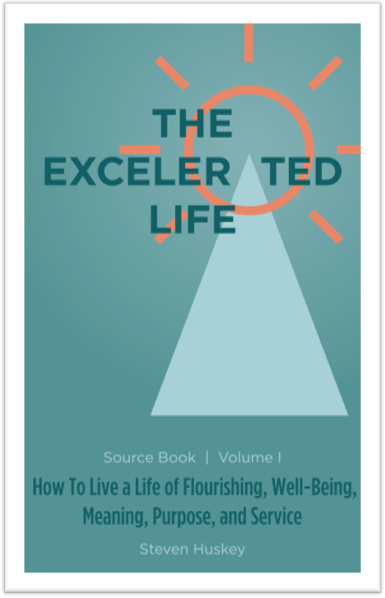
In his book Start With Values, Bradley Hook stresses the importance of values. Values bring happiness. They give clarity. And actions aligned with values bring fulfillment.
However, many of us don’t approach work or life by thinking of values first. Typically, we set goals based not on values but on perceived desires, others’ expectations, or external pressures.
Few stop to define what truly matters first, before starting the goal-setting process.
“When values are unclear, decisions are reactive. When values are clear, decisions become obvious.”
In the Excelerated Life™ framework:
- Goals represent the destinations we are aiming for.
- Actions are the daily steps that take us to our goal.
- Values act as the internal compass that ensures our goals point us in the right direction.
Using values as a compass keeps you on track. No compass? You might move fast…just in the wrong direction.
What Are Excelerated Values™?
To live your values, you must first know what they are. Thomas Leonard, the originator of Life Coaching, wrote: “Values are the interests or qualities that attract you. A value is something you naturally feel is important to you — whether it’s beauty, creativity, family, honesty, friendships, or anything else of worth. You’ll realize its importance by the strength and depth of the feelings it awakens inside you.”
Values are your consciously chosen guiding principles; the standards you live by, even when no one is watching. They represent behaviors and activities that bring us joy, contentment, and well-being when we engage in them. We all have values, whether we realize them or not, whether we can name them or not. We all value some qualities over others, but we aren’t always aware of what those are.
There are many goals, actions, and behaviors that we can choose, but if we attempt them without considering our values, we find they are not as desirable or fulfilling as we imagined. One of the keys to creating your life is to choose your values, then consciously take steps to live them; to use your values as a compass.
The Cost of Unclear Values
A practice of the Excelerated Life™ is to act on principles and values, not on feelings.
When we are unclear about our values, we are apt to act on our feelings in the moment. When this happens, we take our identity from our behavior. It looks like this: Feelings > Actions > Identity.
However, Eric Greitens, former Navy SEAL and author, says if that’s how we approach life, we have those words backwards. We want to live them in the opposite direction: Identity > Actions > Feelings.
“You begin,” Greitens writes, “by asking, ‘Who am I going to be?’ . . . So what’s next? Act that way. . . the way you act will shape the way you feel. . . If you want to feel differently, act differently. . . ”
Living from feelings instead of your identity and values has a negative impact.
- Decision fatigue — When your values are unclear, even small choices take more energy because you have no steady inner standard to guide you.
- Overcommitment — Without clear values, it becomes much easier to say yes to things that seem urgent or pleasing but do not truly fit your priorities.
- Misaligned relationships — When you are not grounded in your values, you may drift into relationships shaped more by approval, habit, or pressure than by mutual truth and respect.
- Chasing goals that don’t satisfy — If your goals are not anchored in what matters most, you can achieve them and still feel empty, restless, or strangely disappointed.
- Living by other people’s priorities — In the absence of clear values, outside expectations can quietly take over and begin directing your time, energy, and attention.
Think about this question: Where in my life do I feel tension, friction, or quiet dissatisfaction? That’s often a values misalignment, not a productivity problem.
The Shift: From Drifting to Deliberate
How would your life be different if you chose the values you live by? What if you went through an exercise to consider and choose values that you want to live out? What new meanings might you discover? How would knowing your values help you in deciding on the best behavior in a specific situation?
Defining your values is a necessary first step. It’s how you move from drifting to deliberate living. If you primarily act based on how you feel rather than what you really want, or if what you say you want does not align with your actions, you may be drifting.
Drifting looks like this: reacting to events rather than responding thoughtfully. Saying “yes” too quickly or simply in order to please. Having unclear priorities. Looking outward to others for validation.
Conversely, deliberate living looks like this: making intentional choices. Setting clear boundaries. Pursuing aligned, meaningful goals. Living with internal clarity.
Activating Excelerated Values™
Contemplating what is important to us — and how we express our Valid Values — brings us into greater congruence with our lives. We begin to live more authentically, more intentionally, more aligned with who we are and who we want to be.
But clarity alone is not enough. Values must be lived.
Here is a simple way to begin.
{And here is a tool that can help you with these steps.)
Step 1: Identify Your Core Values
Start broad, then refine.
List 10–15 values that resonate with you
Narrow them to 5–7
Then refine again to your top 3–5
Ask yourself:
What matters most to me when life is at its best?
Don’t rush this step. This is foundation work.
Step 2: Define Them Clearly
A value that is undefined is rarely lived.
Take each of your top values and make them personal and practical:
What does this value mean in my life?
What does it look like in action—on a normal Tuesday?
Example:
Integrity → I keep my word, tell the truth, and align my actions with my beliefs, even when it’s inconvenient.
Clarity creates consistency.
Step 3: Audit Your Life
Now, gently hold your life up against your values.
Ask:
Where am I living in alignment?
Where am I out of alignment?
Look honestly at:
Your time
Your energy
Your money
Your relationships
No guilt here. Just awareness. Awareness is where change begins.
Step 4: Make One Small Realignment
This is where many people overreach and stall.
Keep it simple. Keep it doable.
Choose one value.
Choose one area of your life.
Make one small shift.
Examples:
Value: Health → 10-minute daily walk
Value: Relationships → one intentional conversation
Value: Learning → read 5 pages per day
Small steps, taken consistently, create meaningful change.
Step 5: Use Values as a Daily Filter
Before making decisions, large or small, pause and ask:
Does this align with what matters most to me?
That one question can save you time, energy, and regret. It won’t make every decision easy, but it will make them clearer.
Simple Practices for Living Your Values
Living your values doesn’t require dramatic change. It simply requires daily attention. Try these small practices:
The 60-Second Values Check:
Pause and ask, What matters most right now?
Values in Motion:
Choose one value each morning and look for ways to live it intentionally throughout the day.
Evening Alignment Review:
Reflect: Where did I live my values today? Where did I drift?
These small check-ins keep your compass pointed true.
Use Your Values as a Compass
You don’t need more goals. You need clearer values. When your values are clear:
decisions simplify
priorities sharpen
relationships deepen
life feels more coherent
As one source puts it, “Some of life’s decisions are really about determining what you value most.” When many options seem reasonable, your values become the steady guide that points you forward.
And when your life is aligned with your Valid Values, the principles you have chosen deliberately, you experience something powerful:
Clarity.
Consistency.
Congruence.
And with that, a quiet sense that your life fits. An Excelerated Life™ isn’t created by doing more. It’s built by aligning more, one choice, one action, one day at a time. That’s how you embrace your Excelerated Life™!
Take five minutes today and identify just one value you want to live more fully this week.
Share your experience by leaving a comment below.
Excelerated Values™ – defining and living your Valid Values – is one practice for creating your Excelerated Life™, a life of flourishing and well-being, and a life of meaning, purpose, and service.
Read more about the Excelerated Life™.
Resources:
Greitens, Eric. Resilience: Hard-Won Wisdom For Living A Better Life. New York: Houghton Mifflin Harcourt Publishing Company, 2015.
Hook, Bradley. Start with Values. Hatherleigh Press, 2024.
Leonard, Thomas. The 28 Laws Of Attraction. New York: Scribner, 1998.
This blog post includes research information and suggestions provided by ChatGPT, an AI language model developed by OpenAI. The content was generated with AI assistance and is intended to provide information and guidance. Please note that the suggestions are not official statements from OpenAI. To learn more about ChatGPT and its capabilities, you can visit the OpenAI website. https://openai.com/