

There comes a point in life when the accumulation that once felt natural begins to feel heavy. The tools, possessions, and even commitments that served us well during the first journey may no longer fit the road ahead. The second journey invites a different kind of wisdom — learning to travel a little lighter.
On the First Journey
As a husband and father, raising a growing family, I didn’t pay any attention to so-called clutter or to being organized. We didn’t accumulate goods just for the sake of having them, and we didn’t engage in conspicuous consumption. We weren’t trying to “keep up with the Joneses” (and we really did have some neighbors named Jones).
But we had work clothes for our jobs (coats and ties were required back then), work clothes to work around the house in, and leisure clothes for summer and winter. We had the good dishes, the everyday dishes, and the fine china. The good silver and the everyday cutlery. Every day glasses and “company” glasses.
I once wrote that, back then, I wasn’t familiar with the concepts of clutter, decluttering, or organizing. I mentioned the two large trash bags of beer huggies I had collected during our travels; the years and years’ worth of “Organic Gardening” magazines that I hung on to in case I ever became an organic gardener; the dozen or more wind chimes hanging on my back porch.
You get the picture. I can’t say we “needed” all that stuff, but it was part of our life and our lifestyle during that phase. I suspect you can identify.
Organizing for the Second Journey
As you enter the second journey, that time Richard Rohr calls “the second half of life”, many of the possessions, tools, and paraphernalia that you needed on the first journey are no longer useful. (Although, to be honest, I’m not sure that 250 beer huggies were ever useful!)
As Rohr writes: “The rules are all different now, and we often see it in older folks’ freedom to give things away. [Keep in mind that the second journey or life’s second half isn’t strictly defined by age.] Hoarding, possessing, collecting, and impressing others with their things, their house, or their travels are of less and less interest to them.”
Decluttering and organizing, helpful at any stage, become a welcome and useful tool on this second journey.
Love What You Have
The second half of life requires inner organization — clearing mental clutter to make space for spiritual growth. Often, the clutter in our homes mirrors clutter in our lives — too many commitments, too many obligations, too many expectations we no longer need to carry. Practicing Excelerated Organization™ doesn’t mean achieving perfect order. It’s simply a way to create enough space and simplicity that what truly matters can flourish.
“Your concern,” says Rohr, “is not so much to have what you love anymore, but to love what you have – right now. This is a monumental change from the first half of life, so much so that it is almost the litmus test of whether you are in the second half of life at all.”
Clearing the mental clutter is necessary but difficult to do without also addressing physical clutter. So if you are feeling the urge to lighten the load to help make your journey easier, let’s look at three steps to help you get organized. These are three of my favorite decluttering tools: the “one in, one out” rule, the PLACE method, and the Zorro Circle.
One In, One Out
Stop clutter from entering your home by using a “one in, one out” policy. Here’s how it works.
When you buy something new to bring into the home, decide on one thing you’ll let go of. This is especially helpful for clothes and shoes, but keep it in mind for kitchen gadgets, unusual tools, and toys.
If you’re replacing something that’s broken, toss the broken item first. But, if you’re tempted to hang on to it with the idea that you might be able to fix it, consider this: How many broken items have you repaired in the past? If you’re handy that way, why not repair the damaged item now instead of buying a new one?
Remember, it’s much easier to create a life without clutter by not letting it in to begin with.
Action Step: For every new item you bring into your home, commit to getting rid of one old item.
A PLACE for Everything
PLACE is my acronym for dealing with clutter. It comprises five steps: Purge, keep Like with Like, Access, Contain, and Evaluate. Here’s what it looks like in practice.
P = Purge. Toss obvious trash. Recycle old magazines and catalogs. Donate items you haven’t used in a year. (Keep legal documents and tax records, of course.)
L = keep Like with Like. Store similar items together. Decide where each object lives and keep it there when not in use.
A = Access. Keep frequently used items within easy reach. Store seldom-used items further away. Keep duplicates in the places you need them most.
C = Contain. Use containers that make items visible and easy to access. Clear bins, labeled folders, and drawer dividers — whatever helps you find things quickly. When a collection outgrows its container, weed it down rather than buy more containers.
E = Evaluate. Before you begin, plan the space. What activities happen here? What tools and supplies are needed for each activity center? Without evaluation, you risk merely rearranging clutter rather than truly organizing.
The Zorro Circle
If you’re new to this decluttering business and feel completely overwhelmed, start small. Use the “Zorro circle”. This term comes from a scene in the movie The Mask of Zorro, which Shawn Achor references in The Happiness Advantage. Here’s how he describes it.
Alejandro, the young Zorro, is taught by the old sword master, Don Diego. Diego draws a small circle on the ground. Alejandro must stay within that circle as he duels with Diego. Only after he masters the small circle is he allowed to work from larger and larger spaces. The feeling of control and accomplishment he gets from mastering the small circle allows him to achieve ever greater feats.
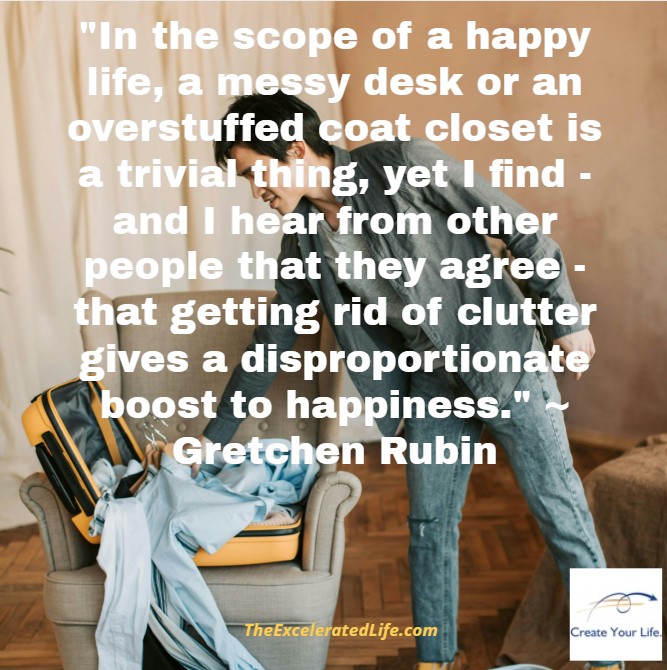
Don’t try to organize your whole life at one time. Just pick one small area and work on it. Instead of trying to organize your entire office, pick one corner of your desk or one desk drawer. Work within your Zorro circle to organize one area of your space.
Once you’ve cleared up that space, commit to keeping it organized and clutter-free. Then, expand your circle as much as you can, always working to keep what you’ve already done in good order.
Letting Go
Decluttering for the second journey was not a specific decision I made; it evolved as I responded to the need to let go of things I no longer needed, to lighten the load of my daily life. It gave me space to sit and contemplate. Space to breathe.
And it all began well before I knew anything about a “second journey”. Letting go of clutter, becoming well-enough organized, and reducing possessions are useful practices at any stage of life. Wherever you are on your journey, here are some suggestions to help you start embracing Excelerated Organization™.
Actions
Commit to the One In, One Out rule: Before you bring home a new item, gadget, article of clothing, or anything else, decide what it is to replace. And think on this: If you already have a “gazingus pen“, do you really need another one?
Pick your “Zorro Circle”: Choose one small area to declutter and organize. Joshua Becker, author and minimalist, recommends starting with “the easiest, most lived-in areas”. This lets you get a quick win in areas where you spend the most time, both of which help fuel motivation to continue. Once you have this area clean and tidy, keep it that way and move on to your next, bigger “circle”.
Use the PLACE method to help you declutter and organize; it is a good PLACE to start. Begin by tossing out broken items, gadgets that no longer work, old phone cords, and other trash. Donate clothes and shoes that no longer fit or that you no longer wear. And keep in mind that clutter gathers in more than our closets. Examine your calendar, your finances, and your emotional spaces. What do you need to let go of?
Another Way
“Owning more,” writes Joshua Becker in Uncluttered Faith, “seems to be the target we’re all aiming for when it comes to happiness . . . But what if that’s the wrong goal? What if we need to turn and go another way?”
Whether you’re still on the “first journey” or you’re well on your way in the “second journey”, those “who would travel happily must travel light.”
Look around your home, your calendar, and your digital spaces. What do they reveal about the target you’re aiming for? What one step could you take today to travel a little lighter? Once you begin, you may find the journey is a little easier and enjoyable. Then, you have begun to embrace your Excelerated Life™!
What would “traveling lighter” look like for you right now? Not someday — today.
What one item, commitment, or responsibility might you release?
Share your comments by leaving a post below.
Excelerated Organization™ — being clutter-free and well-enough organized (able to find what you need when you need it) — is one practice for creating your Excelerated Life™, a life of flourishing and well-being, and a life of meaning, purpose, and service.
Read more about the Excelerated Life™.
Resources:
Achor, Shawn. The Happiness Advantage. New York: Crown Publishing Group, 2010.
Becker, Joshua. Uncluttered Faith. New York: WaterBrook, an imprint of Penguin Random House Christian Publishing Group, a division of Penguin Random House LLC, 2026.
Rohr, Richard. Falling Upward: A Spirituality For The Two Halves Of Life. San Francisco, CA: Jossey-Bass, A Wiley Imprint, 2011.
(Please NOTE: The material in this document is intended for informational and educational purposes only and is not a substitute for professional advice in medical, psychological, legal, or financial matters. The purpose of this article is to educate and inspire. Following the techniques, suggestions, or strategies presented does not guarantee success.)