

Contribution doesn’t have to be extraordinary to be meaningful. Adding value simply means leaving someone a little better because your life touched theirs.
Making the Job Easier
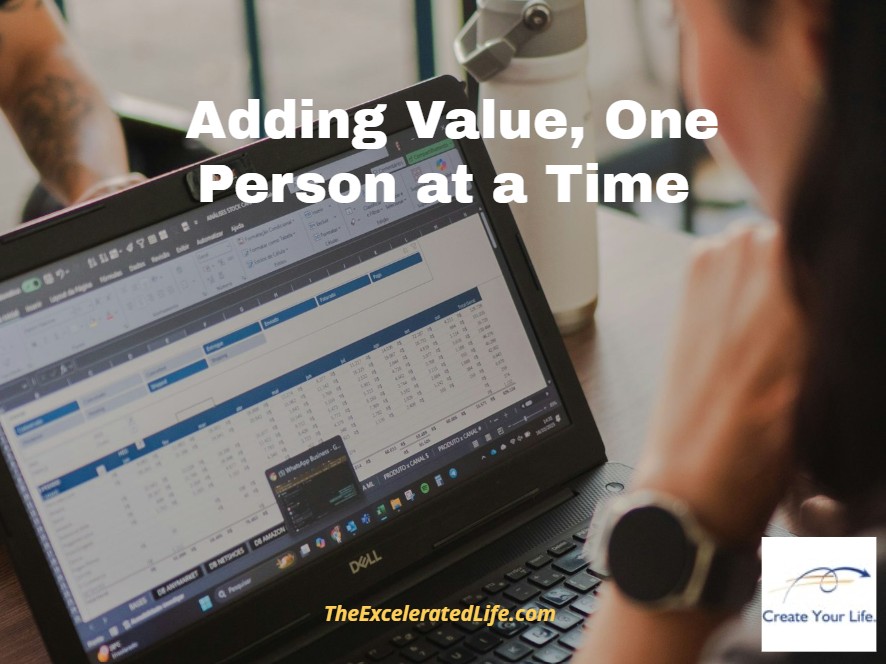
Many years ago, I worked in a job that required me to submit a cumbersome monthly report. And not just me – about a dozen of my co-workers had to complete the same report. We complained loudly at the end of every month, to each other and to anyone who would listen. We tried to find ways to work around the troublesome process. We wasted time hunting for the information we needed. We spent hours on a task that made little difference in our “real” jobs.
Ah, but then Maria came to work for us. She wasn’t our manager. It wasn’t her job to fix our awkward monthly reports. But as it turned out, Maria was quite experienced with spreadsheets. So one afternoon (possibly because she was tired of hearing all of us complain), she created a simple template that automatically organized the information. She tested it, improved it, and shared it with the rest of us.
And it made a difference. It didn’t magically correct all our issues. But it made compiling the report a little easier each month. It saved each of us perhaps fifteen or twenty minutes.
Nothing dramatic happened. Maria didn’t receive any award. No promotion. No standing ovation in the break room.
But the twelve of us used it every month. Maria’s small contribution kept creating value long after the afternoon she spent creating it.
Maria hadn’t set out to “make a difference.” She had simply noticed something that could be better and used something she knew to make it better. That’s adding value. That’s making a contribution.
What Does “Adding Value” Mean?
From the Excelerated Life™ perspective, adding value means intentionally improving someone’s life, work, or well-being through your actions, attitude, knowledge, presence, or service.
Intentionally. Genuinely. Helpfully. These words matter.
Because, face it: You aren’t adding value simply because you did something. What you give must be of value to the recipient. And that’s what you want for true contribution. Excelerated Contribution™ isn’t a way for us to prove how useful we are. It isn’t us trying to make ourselves indispensable. And it isn’t accumulating good deeds or gold stars.
It is being of service. Service is action intended to fulfill another person’s needs or goals.
Adding value isn’t something you do occasionally. It can become a way you move through the world.
Making a contribution isn’t primarily about doing something impressive. Often, it begins with adding value to the person right in front of you. So it can help to periodically ask yourself this question: How can I create value for someone today?
Contribution Is Bigger Than Achievement — and Smaller Than You Think
When we hear words such as “contribution”, “service”, or “making a difference”, our minds can jump immediately to BIG things. Starting a nonprofit. Funding a scholarship. Leading a major community project. Writing a book. Creating a movement. Solving a difficult social problem.
Those are certainly forms of contribution. But if we define contribution only in those terms, most of us will miss dozens of opportunities to contribute every day. Maria didn’t change the world with her spreadsheet. She made twelve people’s jobs a little easier.
And that counts. You don’t have to change the world to make the world better.
You can encourage someone who is discouraged. You can teach someone something you know. You can introduce two people who could help each other. You can solve a small problem. You can share a useful resource. You can listen to someone who needs to talk. You can give your time, your money, or your attention. And sometimes you can simply say hello and smile at someone who seems to be having a difficult day.
We don’t always know what happens after these small interactions. The encouragement you offer may arrive on the exact day someone needs it. The knowledge you share may help another person solve a problem months later. The five minutes you spend listening may help someone feel a little less alone.
That’s one reason adding value isn’t based on measuring the outcome. It’s intentionally making something a little better because you were there.
Look for the Person, Not the Project
This can change how we think about contribution. Instead of waiting for an important cause, a major project, or the perfect volunteer opportunity, begin with the people who are already part of your day. Look around. Who are you going to interact with today? Your spouse? A friend? A coworker? A neighbor? A cashier? A grandchild? Someone at church? The person who delivers your mail?
Then ask: “How can I create value for someone today?”
Notice what happens when you begin carrying that question around with you. It changes what you notice. Instead of merely seeing the coworker struggling with a task, you may recognize an opportunity to share something you know.
Instead of hearing your friend complain about a difficult situation and immediately offering advice, you may realize that what they really need is someone to listen.
Instead of simply noticing that someone has done a good job, you may actually tell them.
The Guiding Question doesn’t prescribe the action. That’s important. Your answer today might be “listen”. Tomorrow it might be “teach”. Next week it might be “give”. The question simply trains your attention toward opportunities to add value.
And this is where we begin to see how the different Excelerated Life™ practices work together. Recall the Guiding Question for Excelerated Relationships™: “Who needs my full attention today?” Sometimes the answer to “How can I create value?” is simply to give someone that attention.
Contribution begins with noticing.
Five Simple Ways to Add Value
“When you choose to intentionally add value to other people, you begin to live a life that matters!” ~ John C. Maxwell
There are probably hundreds of ways to add value to someone’s life. But most fall into a few simple categories.
Give Your Presence
One of the most valuable things you have is your attention. Listen without planning what you’re going to say next. Put down your phone. Look at the other person. Ask a question and actually wait for the answer.
We often assume that contribution requires us to do something for someone. Sometimes what another person needs most isn’t our advice, expertise, or assistance. They need us to be there.
Remember the Excelerated Relationships™ question: “Who needs my full attention today?”
Presence is contribution.
Give Your Encouragement
Notice what people are doing well and tell them. Offer praise. Express appreciation. Give hope to someone going through a difficult time.
And make your encouragement specific. “Good job” is nice. “You handled that difficult conversation with a lot of patience” tells the person exactly what you saw and valued.
Never underestimate the value of sincere encouragement. Most people hear plenty about what they’re doing wrong. Be someone who also notices what they’re doing right.
Encouragement is contribution.
Give What You Know
This was Maria’s contribution. She had knowledge and experience others didn’t, so she used them to make their work easier.
You have knowledge like that, too. After decades of living, working, raising families, maintaining homes, dealing with setbacks, solving problems, learning skills, and occasionally figuring things out the hard way, you know things that could benefit somebody else.
So share what you know. Teach. Mentor. Recommend a book. Demonstrate a skill. Pass along a useful resource. Introduce someone to a person who can help.
One caution: make sure the other person actually wants what you have to offer. Unsolicited advice has an impressive ability to turn “adding value” into “being annoying.” Ask first.
Shared knowledge is contribution.
Give Practical Help
Sometimes contribution is wonderfully unglamorous.
Carry the box. Drive someone to an appointment. Help with the yard work. Fix the troublesome spreadsheet. Make the phone call. Bring dinner. Watch the kids. Solve the small problem that’s making someone’s day harder.
It doesn’t have to be complicated. Ask yourself: “What could I do right now that would make this person’s situation a little better?” Then, if you can, do it.
Practical help is contribution.
Give Your Resources
Sometimes what you have to offer is financial or material. Donate to an organization doing work you value. Buy someone’s lunch. Give useful belongings you no longer need to someone who can use them. Support a family going through a difficult period.
Money is simply another resource we can direct toward creating value. The amount isn’t the point. The intention is.
Giving resources is contribution.
Add Value Without Keeping Score
There’s another part of genuine contribution that’s easy to overlook. Don’t keep score.
Authentic contribution doesn’t say, “I’ll do something for you, and then you’ll owe me.” That’s a transaction.
Nor do we contribute so people will notice how generous, wise, helpful, or indispensable we are. That’s ego wearing a volunteer badge.
True contribution asks: “What would genuinely benefit this person?”
Then we do what we reasonably can and let go of the outcome. Sometimes our contribution will be appreciated. Sometimes it won’t. Sometimes we’ll immediately see the difference we’ve made. Often we won’t.
Maria couldn’t know how much her little spreadsheet template ultimately mattered. Maybe it simply saved fifteen minutes each month. Maybe one of us used those fifteen minutes to solve another problem. Maybe someone went home fifteen minutes earlier. She didn’t need to know. She saw an opportunity to add value, used something she knew, and helped.
Our responsibility is the contribution, not controlling what happens afterward.
Use What You Already Have
Here’s another reason adding value doesn’t need to become complicated: You probably already have what you need.
Ask yourself:
What do I know?
What am I good at?
What have I experienced?
What resources do I have?
What do I care about?
What have I learned that might make somebody else’s path a little easier?
This is where Excelerated Strengths™ joins the circle. Your strengths aren’t simply tools for helping you succeed. They are resources you can use to add value to other people’s lives.
If one of your strengths is humor, perhaps you can lighten a difficult moment. If you have perspective, you may help someone see a problem differently. If you are curious, you may ask the question that helps another person think more deeply. If kindness comes naturally, you may notice needs others overlook. If you love learning, perhaps you can teach or share what you’ve discovered.
Excelerated Values™ helps determine where you want to contribute.
Excelerated Strengths™ helps determine how you can contribute.
Excelerated Focus™ helps you decide where your attention is most needed.
Excelerated Relationships™ helps you understand what another person actually needs.
And Excelerated Selffulness™ and Excelerated Reserves™ help ensure that you have the capacity to keep giving without running yourself into the ground.
The practices don’t operate in isolation. They support and regulate one another. That’s the Excelerated Life™ circle at work.
You Can’t Add Value Everywhere
And that brings us to an important point. Excelerated Contribution™ does not mean saying yes to everyone.
You cannot solve every problem. You cannot meet every need. You cannot volunteer for every worthy organization, support every cause, mentor everyone who needs help, and be available whenever anyone asks.
Try it and you’ll soon have nothing left to contribute. Your time, energy, attention, and money are finite. That’s why contribution must be intentional. Sometimes the most valuable thing you can do is say no to one opportunity so you can say yes to something that more closely aligns with your values, strengths, relationships, and purpose.
This isn’t selfishness. It’s stewardship.
The objective isn’t to contribute everywhere. It’s to contribute where you can create meaningful value.
Maria’s Contribution Didn’t Stop With a Spreadsheet
Something interesting happened after Maria created that spreadsheet. People began asking her questions. Sometimes they were spreadsheet questions, and she happily helped when she could. But gradually her contribution expanded.
She showed a new employee a shortcut that made a routine task easier. She shared information someone else hadn’t seen. When a coworker was struggling with a problem, Maria stopped what she was doing long enough to listen.
None of these things were particularly dramatic. And that’s the point. Maria hadn’t developed a formal “Contribution Plan.” She hadn’t announced that she was embarking upon a campaign to add value to other people’s lives.
She had simply become more attentive. She noticed problems she could help solve. She noticed knowledge she could share. She noticed people she could encourage. She noticed moments when someone needed to be heard.
Adding value was becoming less something Maria did and more a way she moved through the world. And that’s where the Guiding Question can begin doing the same thing for you: **How can I create value for someone today?**
The One-Person Contribution Practice
Here’s one simple way to begin.
For the next seven days, start your morning with the Guiding Question: How can I create value for someone today?
Don’t make a list of ten people. Don’t develop a contribution spreadsheet. Maria has already done enough spreadsheet work for one article.
Choose one person. Then look for one genuine way to add value.
Give your attention.
Offer encouragement.
Share something useful.
Help with a task.
Give a resource.
Solve a problem.
Make an introduction.
Show someone you care.
At the end of the day, ask yourself: Whose life was a little better today because I was part of it?
This isn’t about patting yourself on the back or keeping a tally of your good deeds. It’s about training yourself to notice opportunities for contribution. Because the more you look for them, the more you’ll see.
Adding Value As a Way of Living
Excelerated Contribution™ grew from a simple idea: accomplishment by itself isn’t enough. Certainly, pursue your goals. Develop your strengths. Become more productive. Improve your health. Build your reserves. Create better habits. Flourish.
But don’t let all that development stop with you. Turn some of it outward. Use what you’re becoming to make life a little better for somebody else. That’s where accomplishment becomes contribution.
And contribution doesn’t require you to solve a world problem. Maria didn’t. She fixed a spreadsheet. But because she noticed a problem and used something she knew to help, twelve people’s lives became just a little easier.
That’s adding value.
And perhaps that’s a useful way to think about the purpose of all our self-development. We build our capacity not merely so that we can have more, achieve more, or even flourish more, but so that we have more to bring to our families, our relationships, our communities, and our world.
Flourishing increases our capacity to contribute. Contribution, in turn, brings meaning, purpose, connection, and well-being back into our own lives. Around the circle we go.
So don’t wait until you have more time. Don’t wait until you’ve acquired more knowledge. Don’t wait for the perfect opportunity to make a difference. Start where you are. Use what you have. Notice the person in front of you. And ask: “How can I create value for someone today?”
You don’t have to change the world to make the world better. Make one person’s corner of it a little better today. Then do it again tomorrow. That’s how you practice your way to your Excelerated Life™!
How can you create value for someone today?
Who has added value to your life recently, and what did they do?
Share your experience by leaving a comment below.
* * * * *
Ask better questions. Make better choices. Build better habits. Live an Excelerated Life!
Excelerated Contribution™ is the practice of using your abilities, experiences, and opportunities to create value for others, leaving people and the world better than you found them while living a life of meaning and purpose. It is one practice for creating your Excelerated Life™, a life of flourishing and well-being, and a life of meaning, purpose, and service.
Read more about the Excelerated Life™.
_____
This blog post includes research information and suggestions provided by ChatGPT, an AI language model developed by OpenAI. The content was generated with AI assistance and is intended to provide information and guidance. Please note that the suggestions are not official statements from OpenAI. To learn more about ChatGPT and its capabilities, you can visit the OpenAI website.
_____
(Please NOTE: The material in this document is intended for informational and educational purposes only and is not a substitute for professional advice in medical, psychological, legal, or financial matters. The purpose of this article is to educate and inspire. Following the techniques, suggestions, or strategies presented does not guarantee success.)