
Distraction isn’t always the enemy of productivity. Unintentional distraction drains energy. But intentional wandering restores it.
[Title Photo By Cottonbro Studio]
When Trying Harder Made Things Worse
I sat down at my desk, determined to focus. I had done everything “right.” Notifications off. Email closed. Phone in another room. Coffee within reach. I planted myself in my chair, leaned forward, and tried to force my attention to cooperate.
Nothing happened.
My mind felt thick and sluggish. I reread the same paragraph again and again, making it worse each time. The harder I tried to focus, the tighter my shoulders became and the foggier my thinking felt. Eventually, frustrated, I stood up and went outside. No podcast. No agenda. No “thinking it through.” I just walked.
About five minutes in, something shifted. A sentence arrived, clean and clear. Then another. By the time I turned back toward the house, the idea I’d been wrestling with had quietly lined itself up.
That was the moment I realized something most productivity advice gets wrong: More control isn’t always the answer. Sometimes the most productive move is letting go.
Josh Davis captures this paradox in Two Awesome Hours, writing that to stay on task, we must master two skills: removing distractions and letting our minds wander. Tighten your grip on attention too much, and it slips through your fingers. Loosen it wisely, and clarity returns.
This is where Excelerated Productivity™ takes a different path, one that respects focus and the strange, necessary gift of distraction.
The Myth of Constant Focus
Modern productivity culture worships uninterrupted attention. We praise deep work, long stretches of concentration, and heroic discipline. And don’t get me wrong — focus matters. A lot.
But the myth is this: If I could just focus longer, harder, and without interruption, everything would work. That belief quietly turns productivity into a test of character. When focus fades, we assume we’re undisciplined, lazy, or distractible by nature.
In reality, what’s usually happening is much simpler: We’re mentally fatigued.
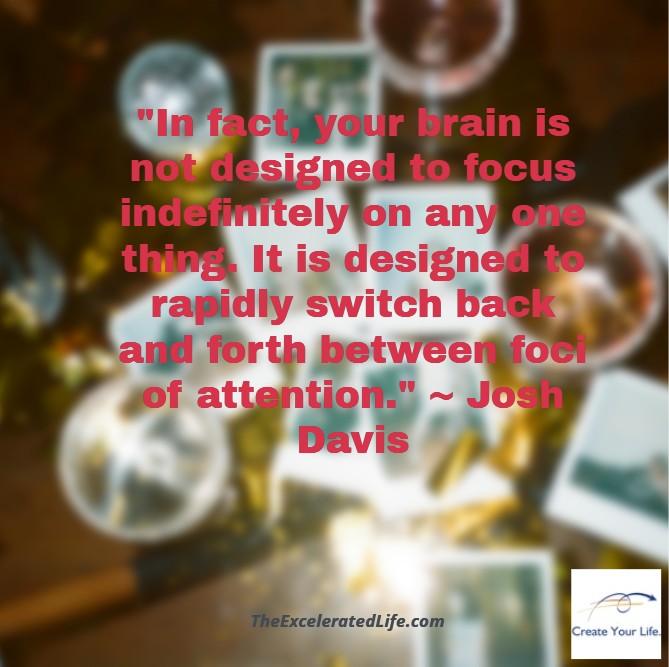
Sustained attention consumes energy. Your brain isn’t built to lock onto a single task indefinitely. When we try to override that reality, productivity doesn’t improve; it degrades. We stay busy, but our thinking narrows. We push, but the quality drops.
Excelerated Productivity™ starts with a different assumption: Productivity isn’t about forcing attention. It’s about managing energy and rhythm.
How Attention Really Works
Attention is your ability to notice what’s happening and choose what to focus on. It’s how your brain selects and processes information—and it’s a limited, valuable resource.
You already know this intuitively. You’ve felt it:
- after a long meeting, when your brain goes dull,
- after hours of screen time when nothing quite lands,
- after pushing through without pause and wondering why you’re exhausted.
Attention comes in different forms—focused, sustained, divided, executive—but all of them draw from the same finite well. When the well runs low, effort alone won’t refill it.
This is where the paradox enters.
When attention starts to slip, the answer isn’t always more discipline. Sometimes the answer is intentional release.
What Happens When the Mind Wanders
When you let your mind wander, on purpose and without external input, your brain shifts into a different mode. This is the mental space where connections form, insights emerge, and meaning gets processed.
It’s why:
- ideas arrive in the shower,
- clarity shows up on walks,
- solutions appear when you stop staring at the screen.
This isn’t laziness. It’s not distraction in the sloppy sense. It’s your brain doing background work that focused attention can’t do alone.
Excelerated Productivity™ recognizes that insight requires space.
If focused attention is the hammer, wandering attention is the workbench where pieces quietly fit together.
The Crucial Distinction: Two Kinds of Distraction
Here’s where we have to be honest. Not all distractions are helpful.
Unintentional Distraction
This is the kind most of us know all too well:
- compulsive phone checking
- endless scrolling
- bouncing between tasks
- reacting instead of choosing
This type of distraction fragments attention and drains energy. It leaves you feeling busy but oddly empty.
Intentional Mental Wandering
This is something else entirely:
- chosen, not compulsive
- time-limited, not endless
- restorative, not numbing
- free from metrics, notifications, and noise
Intentional wandering doesn’t hijack attention. It resets it. Excelerated Productivity™ doesn’t celebrate distraction. It discerns it.
One kind scatters your energy. The other gives it back.
How Over-Focus Can Backfire
There’s another subtle danger to nonstop focus: tunnel vision.
When you grip attention too tightly, you may:
- miss better questions,
- cling to the wrong approach,
- push forward on misaligned goals,
- stay busy instead of being effective.
Brief mental wandering widens perspective. It interrupts unhelpful loops and creates room for recalibration. Sometimes the most productive question isn’t “What else can I do?” It’s “Is this the right thing to be doing now?”
The Excelerated Productivity™ Reframe
Here’s the heart of this practice:
Productivity isn’t about holding attention tighter. It’s about knowing when to focus and when to let go.
Excelerated Productivity™ works through cycles, not strain.
Focus → Release → Return
- Focus deeply for a short, intentional period.
- Release attention deliberately, without guilt.
- Return refreshed, clearer, and more effective.
This is strategic renewal. And it aligns beautifully with Excelerated Acceptance™: instead of fighting the natural rhythms of your mind, you work with them.
Practical Ways to Use “Good Distraction”
Here are simple, realistic ways to use intentional wandering to support productivity.
1. The Focus–Wander Rhythm
Work in focused blocks, then step away briefly.
- No phone.
- No input.
- Just space.
Even five minutes can restore clarity.
2. Movement as Thinking
Walking, stretching, or gentle movement engages the body and frees the mind.
You’re not avoiding work; you’re letting your brain process it differently.
3. Sensory Resets
Single-sense attention can calm and reset mental noise:
- looking out a window,
- listening to instrumental music,
- slow breathing.
4. Question-Based Wandering
Pose a question, then stop trying to answer it.
Let the solution surface on its own.
This is especially powerful for complex or creative work.
5. Planned Permission
Schedule wandering the same way you schedule focus.
When wandering has a place, it no longer feels like procrastination.
When Distraction Is a Signal
Not all distraction is a problem. Sometimes it’s information. Mental resistance can signal:
- fatigue,
- emotional overload,
- misalignment,
- the need for clarity rather than effort.
Instead of asking, “Why can’t I focus?” try asking:
- Am I depleted or unclear?
- Do I need rest or direction?
- Is this task still aligned with my priorities?
Excelerated Productivity™ treats distraction as feedback, not failure.
Designing Your Productivity Rhythm
This approach asks you to stop measuring productivity only by hours worked or tasks completed.
Instead, you design a rhythm that respects:
- attention limits,
- energy cycles,
- mental renewal,
- meaningful progress.
That might look like:
- shorter focus sessions,
- regular movement breaks,
- intentional pauses,
- fewer tasks done better.
The goal isn’t to do more. The goal is to do what matters – with clarity and presence.
How This Fits the Excelerated Life™
This approach to productivity doesn’t stand alone.
- Excelerated Acceptance™ teaches you to stop fighting reality, including mental limits.
- Excelerated Strengths™ helps you use curiosity, perspective, and self-regulation wisely.
- Excelerated Habits™ builds rhythms that support focus and renewal automatically.
Excelerated Productivity™ becomes less about squeezing output from your life and more about aligning effort with energy.
Call to Action
Remember, distraction isn’t always the enemy of productivity. Unintentional distraction drains energy. But intentional wandering restores it. Excelerated Productivity™ isn’t about more control; it’s about wiser rhythm.
This week, experiment. Choose one focused work session. When your attention fades, don’t force it. Step away, briefly and intentionally. Walk. Breathe. Stare out a window. Then return and notice what’s different.
You may discover that letting go — at the right moment — is the most productive move you can make. It just might be the next step on the path to embracing your Excelerated Life™!
When does your best thinking actually happen?
Where might you be mistaking depletion for lack of discipline?
Share your thoughts by leaving a comment below.
Excelerated Productivity™ — improving efficiency and effectiveness — is one practice for creating your Excelerated Life™, a life of flourishing and well-being, and a life of meaning, purpose, and service.
Read more about the Excelerated Life™.
Resources:
Davis, Josh. Two Awesome Hours. New York: HarperCollins Publishers, Inc., 2015.
This blog post includes research information and suggestions provided by ChatGPT, an AI language model developed by OpenAI. The content was generated with AI assistance and is intended to provide information and guidance. Please note that the suggestions are not official statements from OpenAI. To learn more about ChatGPT and its capabilities, you can visit the OpenAI website.